> ## Documentation Index
> Fetch the complete documentation index at: https://docs.e6data.com/llms.txt
> Use this file to discover all available pages before exploring further.
# Architecture
> The logical and physical views of an AgentFlow deployment: what each component does and what actually runs.
export const DocMeta = ({type, applies, owner}) => {
const LABELS = {
tutorial: "Tutorial",
"how-to": "How-to guide",
explanation: "Explanation",
reference: "Reference"
};
return
{LABELS[type] || type}
{applies ? Applies to: {applies} : null}
{owner ? Owner: {owner} : null}
;
};
## Logical view
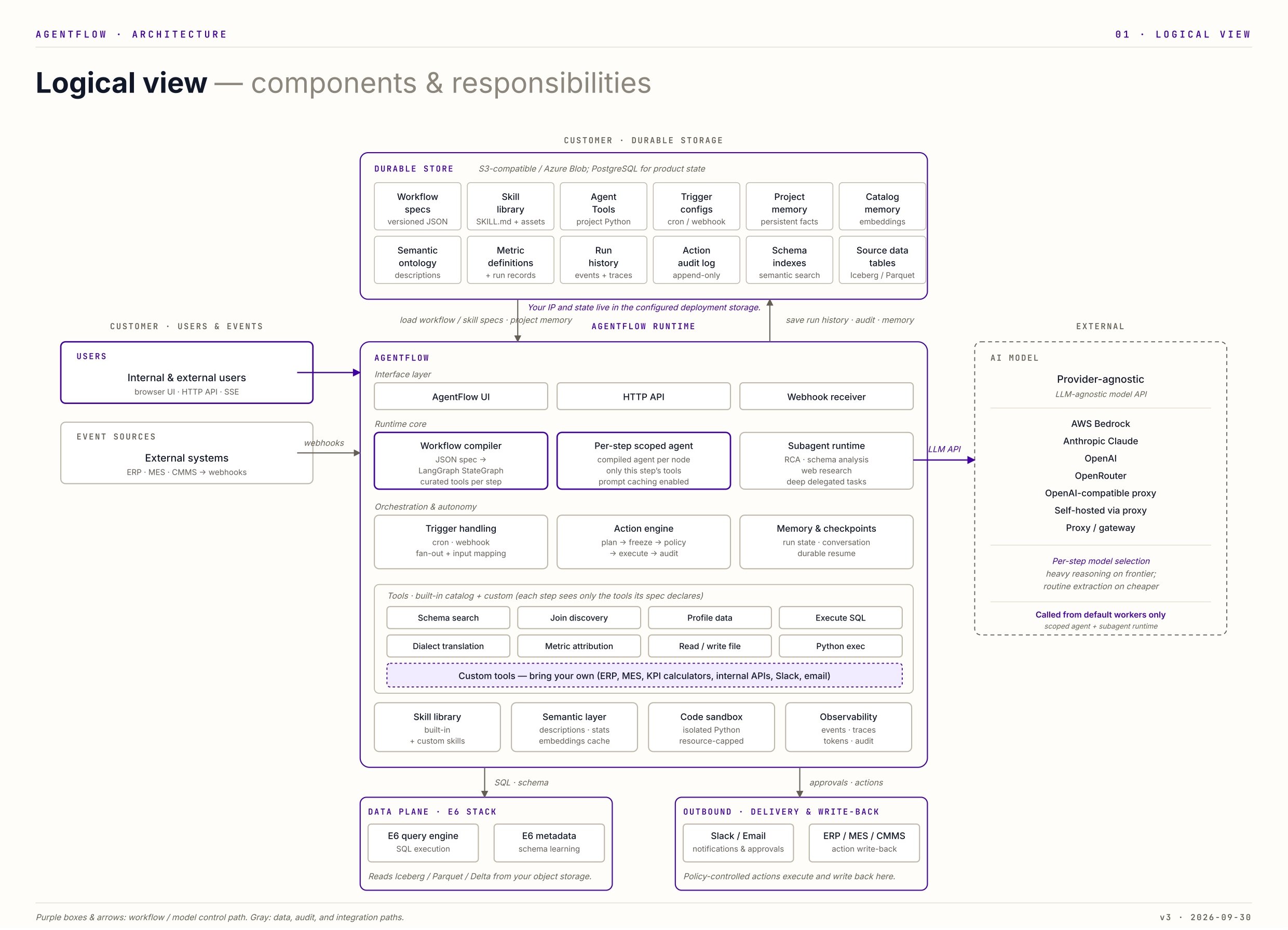 An AgentFlow deployment has a central runtime and four areas around it:
| Area | What it holds |
| - | - |
| Your durable storage (top) | Versioned workflow specs, skill library, Agent Tools, trigger configs, project and catalog memory, semantic ontology, metric definitions, run history, action audit log, schema indexes and source data tables |
| Your users and event sources (left) | Internal and external users through the browser UI, HTTP API and SSE; external systems such as ERP, MES and CMMS through webhooks |
| AgentFlow runtime (center) | Interface layer, workflow compiler, per-step scoped agents, subagent runtime, trigger handling, action engine, memory and checkpoints, tool catalog, skill library, semantic layer, code sandbox, observability |
| External AI models (right) | Provider-agnostic model API, called only from the default worker runtime |
| e6data stack and outbound delivery (bottom) | The e6data query engine runs SQL on Iceberg, Parquet and Delta tables in your object storage; Slack, email and ERP, MES or CMMS receive notifications, approvals and write-backs |
Your IP (workflows, skills, context and audit history) stays in the deployment's configured storage.
## Physical view
An AgentFlow deployment has a central runtime and four areas around it:
| Area | What it holds |
| - | - |
| Your durable storage (top) | Versioned workflow specs, skill library, Agent Tools, trigger configs, project and catalog memory, semantic ontology, metric definitions, run history, action audit log, schema indexes and source data tables |
| Your users and event sources (left) | Internal and external users through the browser UI, HTTP API and SSE; external systems such as ERP, MES and CMMS through webhooks |
| AgentFlow runtime (center) | Interface layer, workflow compiler, per-step scoped agents, subagent runtime, trigger handling, action engine, memory and checkpoints, tool catalog, skill library, semantic layer, code sandbox, observability |
| External AI models (right) | Provider-agnostic model API, called only from the default worker runtime |
| e6data stack and outbound delivery (bottom) | The e6data query engine runs SQL on Iceberg, Parquet and Delta tables in your object storage; Slack, email and ERP, MES or CMMS receive notifications, approvals and write-backs |
Your IP (workflows, skills, context and audit history) stays in the deployment's configured storage.
## Physical view
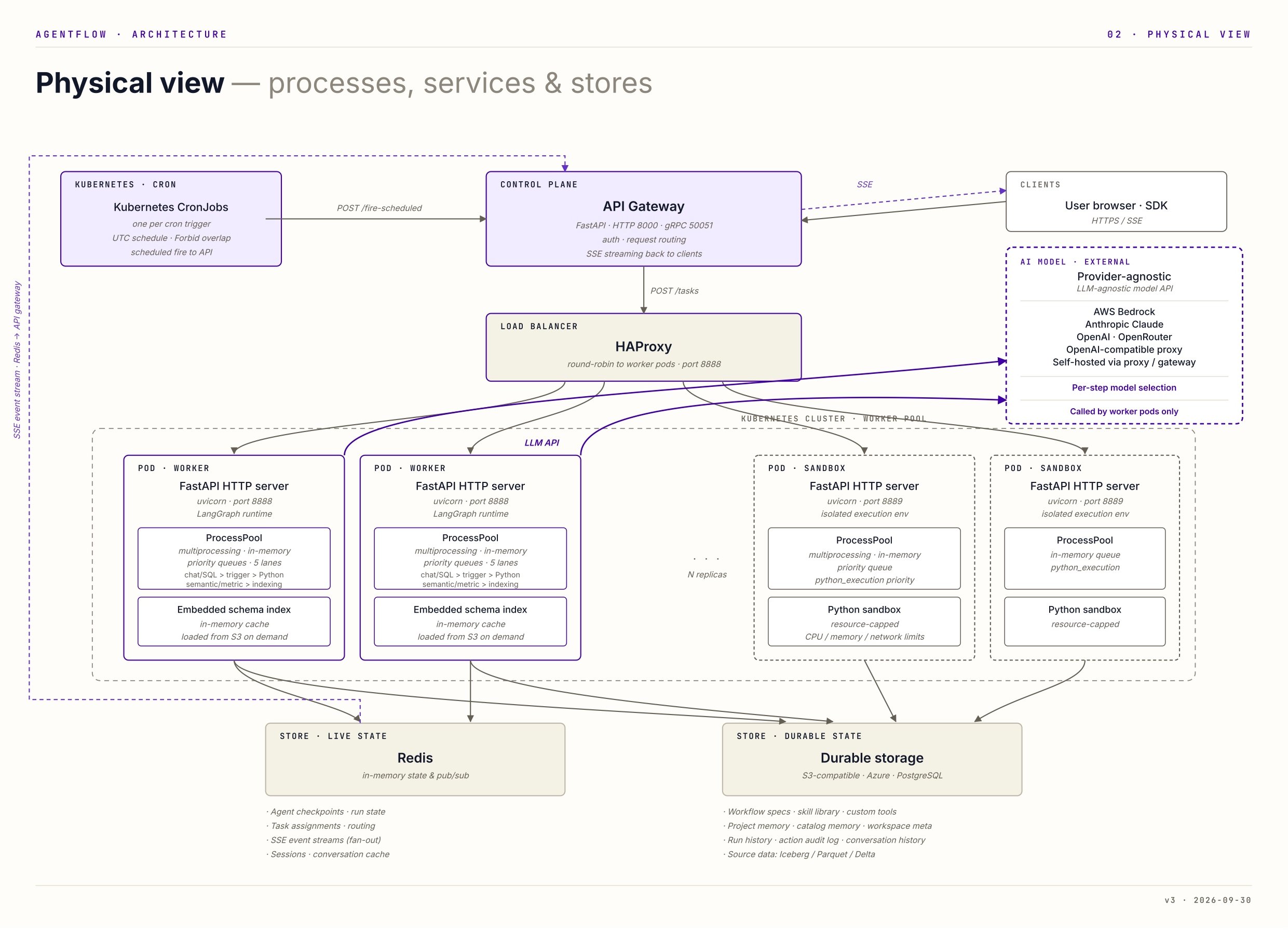 The runtime is a Kubernetes-native deployment:
| Component | Role |
| - | - |
| API gateway (FastAPI) | Authentication, request routing, task submission, and SSE streaming back to clients. HTTP 8000, gRPC 50051. |
| HAProxy | Load-balances task submissions to worker pods. |
| Worker pods | Run the LangGraph agent runtime with an in-memory multiprocessing priority queue. Five lanes: chat and interactive SQL, trigger-started work, Python execution, semantic-layer and metric work, and indexing. No external task broker. |
| Sandbox pods | Isolate Python execution and validation. They get no application credentials, IRSA credentials or internal service token. Production images can add an `nsjail` boundary. |
| Kubernetes CronJobs | One per enabled cron trigger. Webhook and manual runs enter through the API. |
| Redis | Live coordination: task assignments, event streams, checkpoints, locks and caches. |
| Durable storage | Product state and history. S3-compatible storage or Azure Blob Storage; PostgreSQL for product storage in supported deployments. GCS is supported for telemetry delivery only. |
LLM calls come only from the default worker pods. The same picture deploys onto hosted infrastructure, your cloud or VPC, sovereign or private clouds, and on-premises Kubernetes. See [Deployment models](/agentflow/operate/deployment-models).
This documentation is built and hosted on [Mintlify](https://mintlify.com), a developer documentation platform.
The runtime is a Kubernetes-native deployment:
| Component | Role |
| - | - |
| API gateway (FastAPI) | Authentication, request routing, task submission, and SSE streaming back to clients. HTTP 8000, gRPC 50051. |
| HAProxy | Load-balances task submissions to worker pods. |
| Worker pods | Run the LangGraph agent runtime with an in-memory multiprocessing priority queue. Five lanes: chat and interactive SQL, trigger-started work, Python execution, semantic-layer and metric work, and indexing. No external task broker. |
| Sandbox pods | Isolate Python execution and validation. They get no application credentials, IRSA credentials or internal service token. Production images can add an `nsjail` boundary. |
| Kubernetes CronJobs | One per enabled cron trigger. Webhook and manual runs enter through the API. |
| Redis | Live coordination: task assignments, event streams, checkpoints, locks and caches. |
| Durable storage | Product state and history. S3-compatible storage or Azure Blob Storage; PostgreSQL for product storage in supported deployments. GCS is supported for telemetry delivery only. |
LLM calls come only from the default worker pods. The same picture deploys onto hosted infrastructure, your cloud or VPC, sovereign or private clouds, and on-premises Kubernetes. See [Deployment models](/agentflow/operate/deployment-models).
This documentation is built and hosted on [Mintlify](https://mintlify.com), a developer documentation platform.