> ## Documentation Index
> Fetch the complete documentation index at: https://docs.e6data.com/llms.txt
> Use this file to discover all available pages before exploring further.
# Hybrid Data Lakehouse
> Query data across clouds, regions, and on-premises without migrating it, using a main cluster and ancillary clusters.
### Overview
e6data’s Hybrid Data Lakehouse enables enterprises to query data across clouds, regions, and on-premises without migrating data. Powered by a federated SQL engine and hybrid cluster architecture, this feature ensures **data autonomy**, **regulatory compliance**, and **cost efficiency,** all while presenting a **unified query interface** to the user.
**This feature is currently in active development and only available to users on request.**
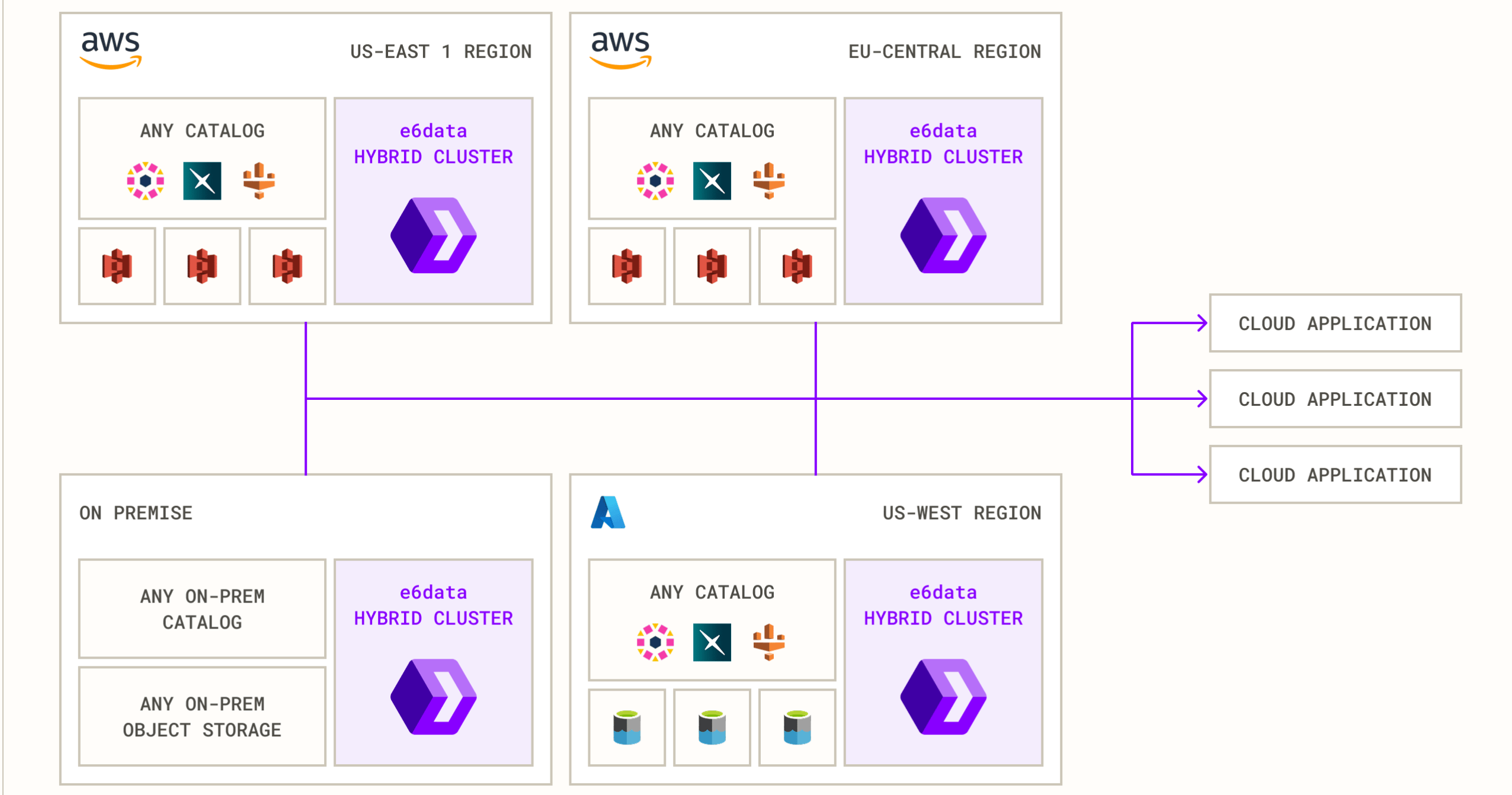 ### What It Does
* Connects heterogeneous data sources across clouds, regions, or ownership boundaries.
* Provides a federated SQL interface for seamless querying.
* Minimizes data movement by **pushing compute to where the data lives**.
* Enhances governance, security, and cost efficiency in distributed environments.
### How It Works
The hybrid lakehouse is built using a **hybrid cluster architecture**:
| Component | Description |
| - | - |
| **Main Cluster** | Acts as the entry point for all client queries. |
| **Ancillary Clusters** | Deployed close to data sources and execute tasks locally. |
| **Routing Layer** | Main cluster routes compute to the appropriate ancillary cluster. |
| **Secure Gateway** | Ensures encrypted communication between clusters. |
| **Federated SQL Engine** | Provides a single query interface for users across sources and clouds. |
| **Metastore Flexibility** | Supports both centralized and federated metastores. |
Even though data and compute are different layers and actions, the **user always experiences a single, unified query layer**.
### How to Set It Up
1. **Identify data sources and federation rules.**
2. **Perform capacity planning** for each region or cloud.
3. **Choose metastore model:**
* Centralized (common metastore)
* Federated (per region/cloud)
4. Use e6data’s automated deployment scripts to:
* Provision hybrid clusters
* Configure auto-scaling
* Wire all clients to the main cluster
The entire setup is **automated** and requires **minimal customer input**.
### Supported Platforms & Features
* Multi-cloud (AWS, Azure, GCP)
* Object storage (S3, ADLS, GCS)
* Metastores (Hive, AWS Glue, etc.)
* Full compatibility with e6data SQL workloads
### Future Enhancements
* Access control policies must be defined centrally at the main cluster.
* Latency may be higher if most data resides away from the main cluster.
* Currently supports statically defined main clusters (dynamic routing is in progress).
### Use Cases
* Global enterprises with **compliance requirements** in multiple geographies
* Organizations seeking to **reduce cross-region/cloud egress fees**
* Businesses wanting to avoid **vendor lock-in** and promote **cloud neutrality**
* Teams managing **data silos** across departments or subsidiaries
This documentation is built and hosted on [Mintlify](https://mintlify.com), a developer documentation platform.
### What It Does
* Connects heterogeneous data sources across clouds, regions, or ownership boundaries.
* Provides a federated SQL interface for seamless querying.
* Minimizes data movement by **pushing compute to where the data lives**.
* Enhances governance, security, and cost efficiency in distributed environments.
### How It Works
The hybrid lakehouse is built using a **hybrid cluster architecture**:
| Component | Description |
| - | - |
| **Main Cluster** | Acts as the entry point for all client queries. |
| **Ancillary Clusters** | Deployed close to data sources and execute tasks locally. |
| **Routing Layer** | Main cluster routes compute to the appropriate ancillary cluster. |
| **Secure Gateway** | Ensures encrypted communication between clusters. |
| **Federated SQL Engine** | Provides a single query interface for users across sources and clouds. |
| **Metastore Flexibility** | Supports both centralized and federated metastores. |
Even though data and compute are different layers and actions, the **user always experiences a single, unified query layer**.
### How to Set It Up
1. **Identify data sources and federation rules.**
2. **Perform capacity planning** for each region or cloud.
3. **Choose metastore model:**
* Centralized (common metastore)
* Federated (per region/cloud)
4. Use e6data’s automated deployment scripts to:
* Provision hybrid clusters
* Configure auto-scaling
* Wire all clients to the main cluster
The entire setup is **automated** and requires **minimal customer input**.
### Supported Platforms & Features
* Multi-cloud (AWS, Azure, GCP)
* Object storage (S3, ADLS, GCS)
* Metastores (Hive, AWS Glue, etc.)
* Full compatibility with e6data SQL workloads
### Future Enhancements
* Access control policies must be defined centrally at the main cluster.
* Latency may be higher if most data resides away from the main cluster.
* Currently supports statically defined main clusters (dynamic routing is in progress).
### Use Cases
* Global enterprises with **compliance requirements** in multiple geographies
* Organizations seeking to **reduce cross-region/cloud egress fees**
* Businesses wanting to avoid **vendor lock-in** and promote **cloud neutrality**
* Teams managing **data silos** across departments or subsidiaries
This documentation is built and hosted on [Mintlify](https://mintlify.com), a developer documentation platform.